
Blog
Typically, EMS billing companies aim to assist EMS providers with revenue cycle services. That means accruing cash collection through a billing process and resulting in reimbursement from payers for the medical services rendered. Besides providing distinguished EMS billing services, EMERGICON believes in acting as a financial advisor for its partner agencies. A financial advisor provides expert […]
Typically, EMS billing companies aim to assist EMS providers with revenue cycle services. That means accruing cash collection through a billing process and resulting in reimbursement from payers for the medical services rendered. Besides providing distinguished EMS billing services, EMERGICON believes in acting as a financial advisor for its partner agencies. A financial advisor provides expert […]
Typically, EMS billing companies aim to assist EMS providers with revenue cycle services. That means accruing cash collection through a billing process and resulting in reimbursement from payers for the medical services rendered. Besides providing distinguished EMS billing services, EMERGICON believes in acting as a financial advisor for its partner agencies. A financial advisor provides […]
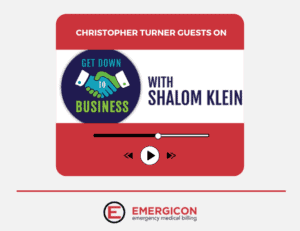
Founder and CEO Christopher Turner, guests on an episode of the radio show and podcast Get Down to Business, hosted by entrepreneur, community leader, and army veteran Scott “Shalom” Klein. During the 10-minute conversation, Christopher discusses how EMERGICON removes the burden of billing from the shoulders of EMS providers. Hop to the 9:45 mark to hear about […]
In an EMS reimbursement cycle, there is always a disparity between the amount billed and collected for an ambulance run. That happens because of allowances, reimbursement variations by payer, and write-off policies. What is billed? When partnering with an EMS agency, a billing company understands the types of write-offs the agency wants to activate. These […]

“We operate with a level of ethics and integrity that makes a difference, and our partners recognize that.” We are inspired by our mission and motivated by our Core Values. Our teams believe that service comes first and rely on hard work and kindness as the bedrock of our success. Encouraging this mindset and […]

“Our clients intentionally put their lives on the line to help and protect others. The notion that we are serving these people is very fulfilling for me.” We are inspired by our mission and motivated by our Core Values. Our teams believe that service comes first and rely on hard work and kindness as the […]

“When we do better for our clients, we do better for ourselves.” We are inspired by our mission and motivated by our Core Values. Our teams believe that service comes first and rely on hard work and kindness as the bedrock of our success. Encouraging this mindset and guiding the business’ frontline is our executive leadership […]
Subscribe to EmergiNews: Industry updates in your inbox
No spam. Just helpful information you won’t want to miss out on.
Categories
Tags