
The Case for Human Judgment in an Age of Automated EMS Billing
AI In EMS Billing
It is hard to get through a single day without a headline about artificial intelligence. AI is transforming industries, automating workflows, eliminating inefficiencies, and — depending on who you ask — either solving every operational problem or creating new ones. The conversation is everywhere, and the billing industry is not immune to it.
Vendors are promising AI-powered claims processing, automated coding, and machine-driven revenue cycle management. The pitch is compelling: faster, cheaper, and just as accurate as a human team — maybe more so.
For most back-office functions, that conversation is worth having.
EMS billing is not most back-office functions.
Between the moment a paramedic closes a patient care report and the moment a clean claim reaches a payer, there is a chain of steps that software cannot make reliably — and getting any one of them wrong costs your agency real money. Understanding where automation helps and where it falls short is one of the most important things an EMS leader can demand from a billing partner.
What a PCR Actually Requires
Every EMS transport generates a patient care report. That report is the foundation of the claim. And reading it accurately requires more than parsing fields in a database.
Medical necessity must be established — not assumed. The level of service must be supported by the documentation. Transport destination matters. Payer-specific requirements vary. Modifiers have to be applied correctly. A claim that looks complete to software may be undercoded, overcoded, or missing the clinical context that justifies reimbursement.
At EMERGICON, every PCR is reviewed by a trained team member before a claim is coded and submitted. That reviewer is looking at the full clinical picture — verifying patient information, confirming medical necessity, conducting a payer review based on destination, diagnosing and coding the run, and checking against applicable fee schedules. Technology supports that process. It does not replace it.
Where Automation Actually Belongs
This is not an argument against technology. It is an argument for knowing where technology earns its place.
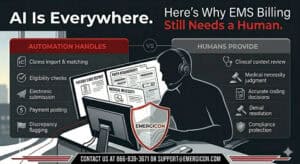
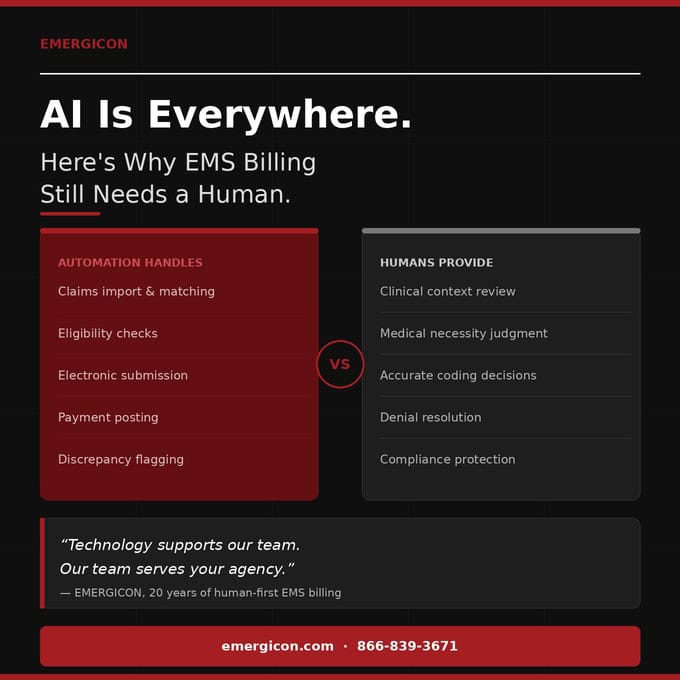
Automation is genuinely valuable in EMS billing when it handles volume, consistency, and speed for tasks that do not require judgment. Importing claims from ePCR platforms. Matching records. Running eligibility checks. Submitting claims electronically to payers. Posting electronic payments. Flagging discrepancies for human review. These are areas where automation reduces error and accelerates throughput — and where EMERGICON deploys it deliberately.
The mistake many billing platforms make is extending automation into stages that require interpretation. Coding a chart is not a data entry task. Resolving a denial is not a routing problem. Managing a patient account call is not a scripted transaction. When automation reaches into those areas, it does not just create errors — it creates errors that are hard to detect because they look like processed work.
The Compounding Cost of Miscoded Claims
A miscoded claim does not always get rejected. Sometimes it gets paid — at the wrong rate. Sometimes it gets paid at a reduced rate that no one flags because the payment posted and the account closed. Sometimes it establishes a pattern with a payer that affects future claims from your agency.
The downstream cost of systematic miscoding is not visible in a monthly report. It shows up over time in collection rates that underperform, in payer relationships that erode, and in audit exposure that accumulates quietly until it becomes a serious compliance problem.
Human review at the coding stage is not a cost. It is protection.
What to Ask Your Billing Partner
If your agency is evaluating billing partners — or reconsidering a current one — the automation question is worth asking directly. Specifically:
- Who reads and codes your PCRs — a person or a system? If a person, what is their background and training?
- At what stages does your platform use automation, and at what stages does a human team member review the work?
- How are miscoded claims identified and corrected, and how quickly?
- What is your denial rate, and what percentage of denials are attributed to coding errors?
The answers will tell you whether your billing partner is using technology to support their team or using technology to replace the judgment your claims actually require.
The Bottom Line
EMS billing sits at the intersection of clinical documentation, payer policy, and compliance — a combination that rewards expertise and punishes shortcuts. The best technology in the industry makes expert billing teams faster and more consistent. It does not make them unnecessary.
Every day, the headlines will tell you AI is the answer. With AI in EMS billing, the better question is: the answer to what, exactly? For the decisions that determine whether your agency is paid accurately, compliantly, and consistently — the answer is still a trained human being who knows what they are looking at.
EMERGICON’s position has not changed in 20 years: technology supports our team. Our team serves your agency. That distinction is why our clients stay — and why their results hold.
To learn more about how EMERGICON approaches EMS billing, contact us at 866-839-3671 or support@emergicon.com.
Be sure to follow EMERGICON on LinkedIn!