
The call ends. The crew clears the scene, restocks the unit, and goes back in service.
For your agency, that is the end of the incident. For the claim, it is the beginning.
Most agencies have never seen the inside of the billing process they are paying for. They see what goes in and what comes back, and very little of what happens between. So here is the middle, step by step.
Each Texas EMS Claim starts with finding the payer
Payer research is the largest team at EMERGICON. That surprises people. It should not.
Crews meet patients on the worst day of their year. Nobody is handing over an insurance card in a ditch on the side of the highway. So when coverage is unclear, and it often is, our team goes and finds it. Secondary coverage. Medicaid managed care assignments. The small regional and replacement plans that automated payer discovery tools miss on a regular basis.
We have tested those tools against our own people. Automation is good at confirming what is already known. It is not good at ambiguity, and this part of the job is nothing but ambiguity.
Here is why it matters to a budget. Claims where coverage was never found do not come back flagged as a problem. They come back as private pay. If your reports show a high percentage of self-pay, some of that is real and some of it is a payer research failure wearing a self-pay costume. It is worth knowing which.
Coding is done by people who know the back of an ambulance
Certified ambulance coders handle level of service, diagnosis, and mileage, working alongside team members who have run calls themselves.
Those are not clerical entries. They are judgments about what happened in the back of that unit, made against Medicare and Medicaid requirements that shift more often than most people outside this business realize.
AI does the parts AI and automation are good at
EMERGICON uses it heavily, and makes no apology for that. Pulling records. Matching patient accounts. Posting routine payments. High volume, repetitive work that machines do faster and more accurately than people.
The company also keeps investing in its own systems, including patented technology, and is building a platform designed around EMS workflows rather than adapted from somebody else’s.
What does not get handed over is coding, denials, payer research, claims follow-up, and patient conversations. Cheap processing is easy to buy. The right process is not.
Follow-up is where the money is won or lost
Assume two billing companies do everything else equally well. The one that collects more is the one that works the claim longer.
Denials get overturned. Misrouted claims get rerouted. Open claims go to a senior team of representatives who stay on them until there is an answer.
The alternative is writing off anything that does not pay on the first pass, which is how an agency loses six figures a year without ever seeing a line item that explains it.
Your patients get The Texan Touch
The ambulance bill is often the last contact a resident has with their department. Crews can do everything right at three in the morning, and a bad phone call six weeks later is what the patient remembers.
When your patients call, they reach an EMERGICON employee in Texas. Trained, patient, and able to explain a bill in plain language without giving anyone the runaround. That is the standard The Texan Touch® was built around, and it is the part of the process we are most protective of.
What comes back to you
The process does not end at payment.
Agencies get documentation feedback, so recurring gaps get closed at the source rather than costing the same revenue twice. They get clean reporting available around the clock, with metrics and projections that hold up when a council member asks a hard question in a public budget hearing. And when Medicare requirements move or a funding mechanism like GEMT changes, they hear it from our team before it reaches the budget.
Account managers, client success managers, and leadership show up at stations, council meetings, and board meetings. That is not an add-on service. It is part of how the work gets done.
Why all of it stays in Texas
Every person who works with your billing lives and works in Texas. No offshore chart review, no offshore data entry, no call center in another country handling your citizens.
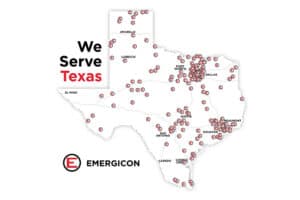
EMERGICON would rather know one state completely than fifty partially. Twenty years in, that decision has held up: more than 200 Texas EMS agencies, 125 people who work on nothing but Texas EMS claims, and the same owner who started the company in 2006.
That is the process. To see how it would apply to your agency’s numbers, ask and we will walk you through it.
Have a question about your agency’s billing performance?
Call us at (877) 602-2060, email info@emergicon.com, or connect with us on LinkedIn.