
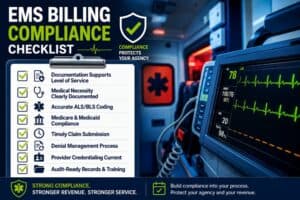
EMS billing compliance is not a one-time audit. It is an ongoing operational discipline. Agencies that treat compliance as a checklist item — something to review annually and then set aside — expose themselves to claim denials, repayment demands, and in serious cases, federal scrutiny.
The agencies that avoid those outcomes are the ones that build compliance into their billing process from the start.
This checklist is a starting point. Use it to identify gaps in your current process and areas where your billing partner should be providing active oversight.
Documentation in EMS Billing Compliance
Every transport has a completed patient care report that supports the level of service billed. Medical necessity is clearly documented, not implied. The patient’s condition and the clinical interventions performed are specific enough to justify the transport level. Signatures or signature refusals are obtained and documented per payer requirements. Crew credentials are documented and current.
Coding Compliance
ALS and BLS transport levels are coded based on clinical documentation, not assumptions. Mileage is calculated correctly from the point of pickup to the destination. Modifiers are applied accurately and only when supported by documentation. Diagnosis codes reflect the patient’s condition at the time of transport.
Payer and Regulatory Compliance
Medicare billing follows current fee schedule rates and coverage criteria. Medicaid billing adheres to Texas-specific rules and prior authorization requirements where applicable. Claims subject to the No Surprises Act are handled with appropriate patient notification and rate transparency. HIPAA protocols govern how patient information is accessed, transmitted, and stored.
Claim Submission and Follow-Up
Claims are submitted within payer-required timely filing windows. Rejected claims are corrected and resubmitted promptly. Denied claims are reviewed, appealed where appropriate, and tracked to resolution. Write-offs require supervisory review and are documented with a denial reason code.
Credentialing and Enrollment
All providers are enrolled with Medicare, Medicaid, and applicable commercial payers. Credentialing is current and renewal deadlines are tracked. New providers are enrolled before they begin billing under the agency.
Audit Readiness
A medical record request process is in place and staff know how to respond. Documentation is retrievable and complete for at least seven years. Billing staff and clinical crew receive regular compliance training. An internal review process identifies patterns in denials or documentation gaps before an external audit does.
A Note on Compliance and Your Billing Partner
Compliance responsibility does not transfer entirely to your billing company. As the provider, your agency is ultimately accountable for what is submitted in your name. The right billing partner operates as a true compliance partner: flagging documentation issues, staying current on regulatory changes, and producing reports that give you visibility into your claims.
EMERGICON’s billing process is built around compliance at every stage. Learn more about our EMS billing services or read our overview of the Medicare fee schedule and its impact on EMS reimbursement.
What Does an EMS Billing Company Do?
If your EMS agency is handling billing in-house, you already know how much work it takes. If you are considering outsourcing for the first time, you may be wondering whether a billing company does more than submit claims.
The answer is yes. Significantly more.
A qualified EMS billing company manages the entire revenue cycle on behalf of your agency, from the moment a call is documented to the moment a balance is resolved. Here is what that actually looks like in practice.
Intake and Documentation Review
Before a claim is ever submitted, a billing company reviews the patient care report for completeness and accuracy. This step catches documentation gaps that would otherwise result in a denial or a downcoded payment. Billing staff are trained to identify when a call’s documentation supports a higher transport level, when medical necessity language is insufficient, and when a claim is not yet ready to go out.
Coding and Claim Preparation
EMS billing compliance involves medical coding specific to prehospital care: transport levels, mileage, procedures performed, and diagnosis codes that reflect the patient’s condition. A billing company employs coders who understand the difference between an ALS 1 and ALS 2 call, when modifiers apply, and how payer-specific rules affect what gets reimbursed.
Claim Submission
Claims are submitted electronically to Medicare, Medicaid, and commercial payers according to each payer’s timely filing requirements. A billing company tracks submission status for every claim and flags anything that does not receive a timely response.
Payment Posting and Reconciliation
When payments arrive, they are posted to each patient account and reconciled against what was billed. This step ensures that payers are paying at the correct rate and that any underpayments are identified and addressed.
Denial Management
Denied claims do not simply become write-offs in the hands of a skilled billing company. Each denial is reviewed, the reason is documented, and a decision is made to appeal, correct and resubmit, or write off based on the circumstances. Patterns in denials are tracked and reported so that upstream issues, whether in documentation, coding, or credentialing, can be corrected.
Patient Account Management
After insurance processes a claim, a patient balance may remain. A billing company manages patient statements, payment plans, and account resolution. This includes handling calls from patients who have questions about their bill, a task that consumes significant staff time when managed in-house.
Reporting and Transparency
A good billing company does not just collect money. It provides the reporting your agency needs to understand where revenue is coming from, where it is not, and why. Metrics like collection rate, days in accounts receivable, denial rate, and average reimbursement per transport give agency leadership a clear picture of financial performance.
Compliance Oversight
EMS billing compliance is governed by Medicare and Medicaid rules, state regulations, HIPAA, and payer-specific requirements that change regularly. A billing company stays current on those changes and ensures that your claims reflect current rules, protecting your agency from audit exposure.
What This Means for Your Agency
An EMS billing company does not replace your clinical team. It handles everything that happens after the call, so your staff can focus on the call itself.
EMERGICON has served Texas EMS agencies for more than two decades, managing the full billing cycle for more than 200 providers. Learn more about what EMERGICON’s EMS billing services include or explore how outsourcing compares to in-house billing to determine what is right for your agency.
Be sure to follow EMERGICON on LinkedIn!