
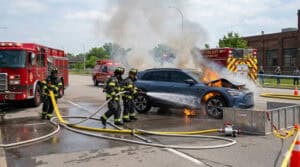
Electric vehicles are here to stay. With millions on Texas roads and the numbers growing every year, fire and EMS departments are responding to a new category of incident, one that is more resource-intensive, more hazardous, and more expensive than anything in the traditional playbook.
The good news: much of that cost is recoverable. The challenge: most departments don’t know how to capture it.
A Different Kind of Fire
An electric vehicle fire is not a routine call. Lithium-ion battery fires burn hotter, reignite without warning, and require specialized suppression techniques including foam, thermal blankets, and in some cases immersion. The response time is longer. The resource draw is heavier. And the cleanup creates contamination concerns that don’t exist after a conventional vehicle fire.
When a department rolls on one of these calls, the costs are real: suppression materials, specialized equipment, extended time on scene, and in some cases gear that cannot be returned to service because of toxic exposure. Those costs land on the city and on the taxpayers unless someone captures them.
EV Manufacturers Often Have Insurance Coverage for Exactly This
Here is what most departments don’t know: major electric vehicle manufacturers carry insurance policies that can cover fire suppression costs when their vehicles are involved in an incident. That means the department that spent three hours on scene, used specialized materials, and potentially had to retire contaminated bunker gear may have a legitimate, billable claim, one that gets paid by a commercial insurer rather than absorbed by the city budget.
This is not speculative. It is a revenue stream that exists right now, and it is one that EMERGICON has been navigating on behalf of Texas departments for years.
It Extends Beyond EVs
The same principle applies to other specialized incidents that strain department resources in ways that standard calls do not: large commercial fires, industrial incidents, oil field emergencies, and mass casualty events involving fleet or commercial vehicles. When a 200-bale hay fire inside a commercial barn draws multiple departments for an extended operation, there is a commercial liability policy somewhere that covers loss and damages, including the materials and time the department expended to protect that property.
The billing for these claims is specific. The language matters. The documentation matters. And the difference between recovering those costs and absorbing them often comes down to whether your billing partner knows how to navigate the claim.
What This Means for Municipalities
Fire and EMS leaders are increasingly being asked to find new revenue streams without increasing the burden on residents. EMERGIFIRE, EMERGICON’s fire billing service, is built around exactly that principle. We recover costs from commercial insurers, fleet policies, and vehicle manufacturers. Your residents are never billed. Your department gets reimbursed for resources it actually spent.
The service is fully customizable. We work with each department to define exactly what gets billed and how, so there are no surprises and no community pushback.
The Bigger Picture
Texas fire and EMS departments are already advocates for legislation that keeps up with the realities on the ground because the call volume changes, the equipment changes, and the hazards change faster than the policy does. EV incident recovery is one of the clearest examples: the vehicles are proliferating, the incidents are increasing, and most departments are still absorbing costs they don’t have to.
We think that should change.
If your department is responding to EV fires, commercial vehicle incidents, or large-scale property events and not recovering those costs, we’d welcome a conversation. Reach us at 866-839-3671 or support@emergicon.com.